
Jia Huang
Senior AI Researcher at A*STAR Singapore · Distinguished Expert, Singularity Intelligence Research Institute · Author
I write about agent architecture from inside the engineering trenches — what the harness actually does, why composing patterns matters more than picking models, and how the next decade of AI systems will be built.
The thesis I keep coming back to: agent architecture is the design of bounded resource allocation under uncertainty. The model spends; the harness budgets.
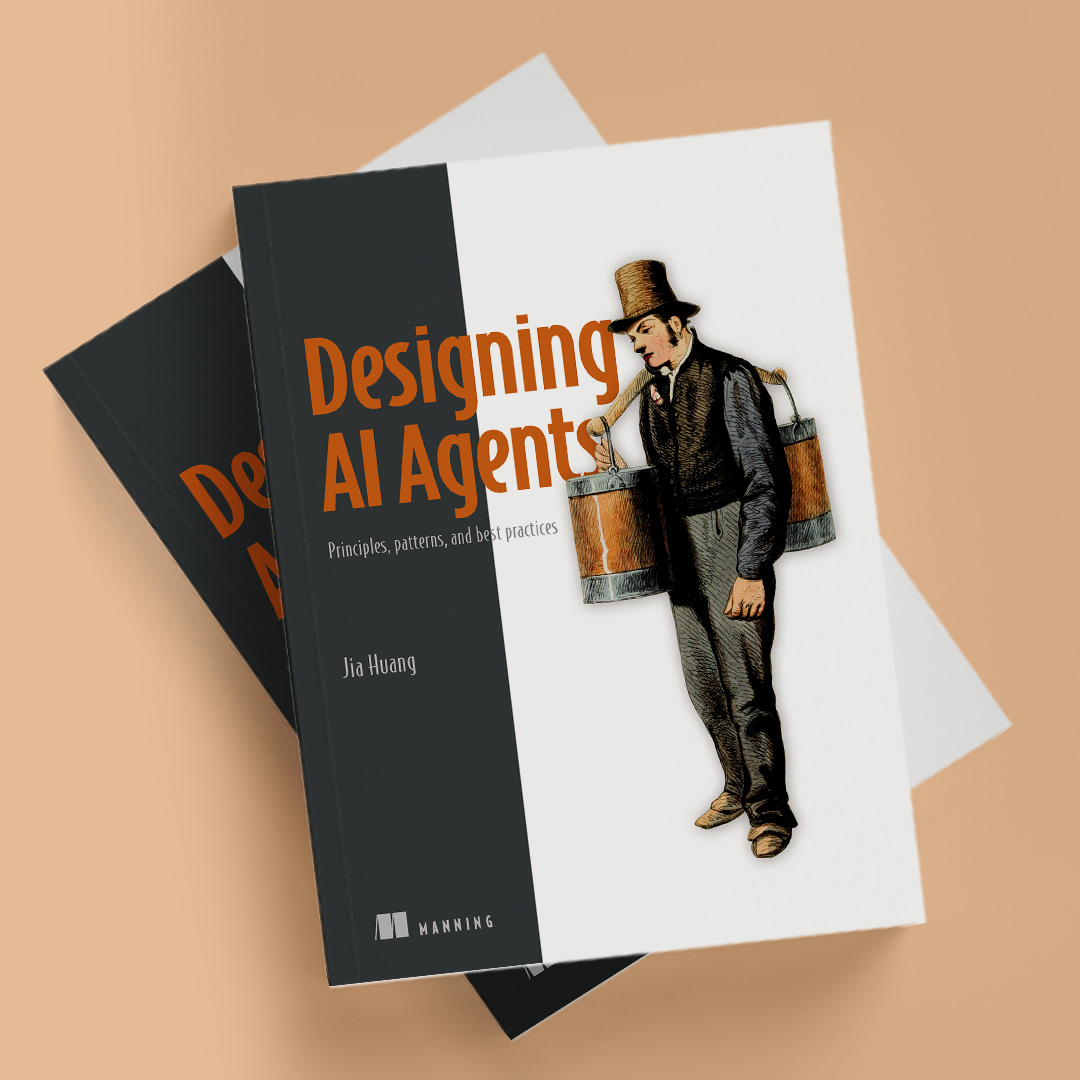
Designing AI Agents — the design-pattern catalogue for production AI agents.
Two buckets, one carrier — every agent design decision is a balance.
Recent Writing
Concepts
Signature concepts in this body of work. Each has a permanent URL so essays and talks can point at the concept rather than re-define it.
Books
- Designing AI Agents — Manning. The design-pattern catalogue for production AI agents: 27 patterns across 7 cognitive functions and 6 topologies.
- RAG from First Principles — Packt. The full RAG stack from first principles — ingestion, chunking, vector stores, retrieval optimization, GraphRAG, Agentic RAG.
- The Claude Code Operating Model — Packt. Skills, MCP, Hooks, agent orchestration, and SDK patterns for team-scale Claude Code environments.
- Selected Chinese-language books on machine learning, GPT, AI agents, RAG, data analysis — cumulative readers in the hundreds of thousands. See Chinese list →
About
Senior AI Researcher at the Agency for Science, Technology and Research (A*STAR), Singapore, and Distinguished Expert at the Singularity Intelligence Research Institute. Focused on AI agent system design, LLM engineering, and enterprise AI applications. I proposed the Dual-Axis Agent Design Framework (cognitive functions × execution topology) and the Pattern Selection Card methodology to guide the design, decomposition, and deployment of complex agent systems.
Before A*STAR, seven years as a senior consultant at Accenture Singapore. Also a certified counsellor with seven years volunteering on a Singapore counselling helpline — a background that quietly shapes how I write about agents.
Newsletter
I write a free newsletter, Agent Design Patterns, on Substack. One essay every 1–2 weeks. Structural observation, not hype.
Or read on Substack directly · LinkedIn.