The Dual-Axis Framework for AI Agent Design Patterns
Cite as: Huang, J. & Zhou, J. T. (2026). A Two-Dimensional Framework for AI Agent Design Patterns. arXiv:2605.13850 · archival DOI 10.5281/zenodo.19036557 · BibTeX ↓
Existing frameworks for LLM-based agent architectures describe systems from a single perspective. Industry guides emphasize execution topology—how information and control flow. Cognitive-science-oriented surveys emphasize cognitive function—what the agent is trying to accomplish. Neither axis alone distinguishes architecturally different systems. The same Orchestrator–Workers topology can realize Plan-and-Execute, Hierarchical Delegation, or Adversarial Verification — three substantially different systems with three different failure modes.
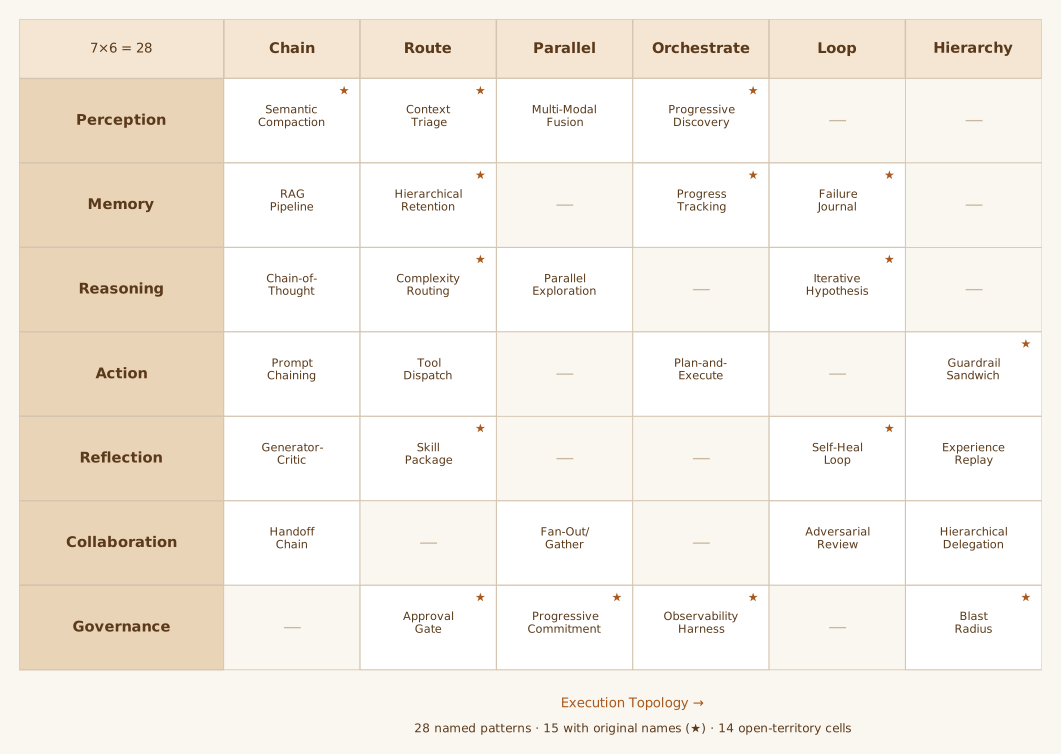
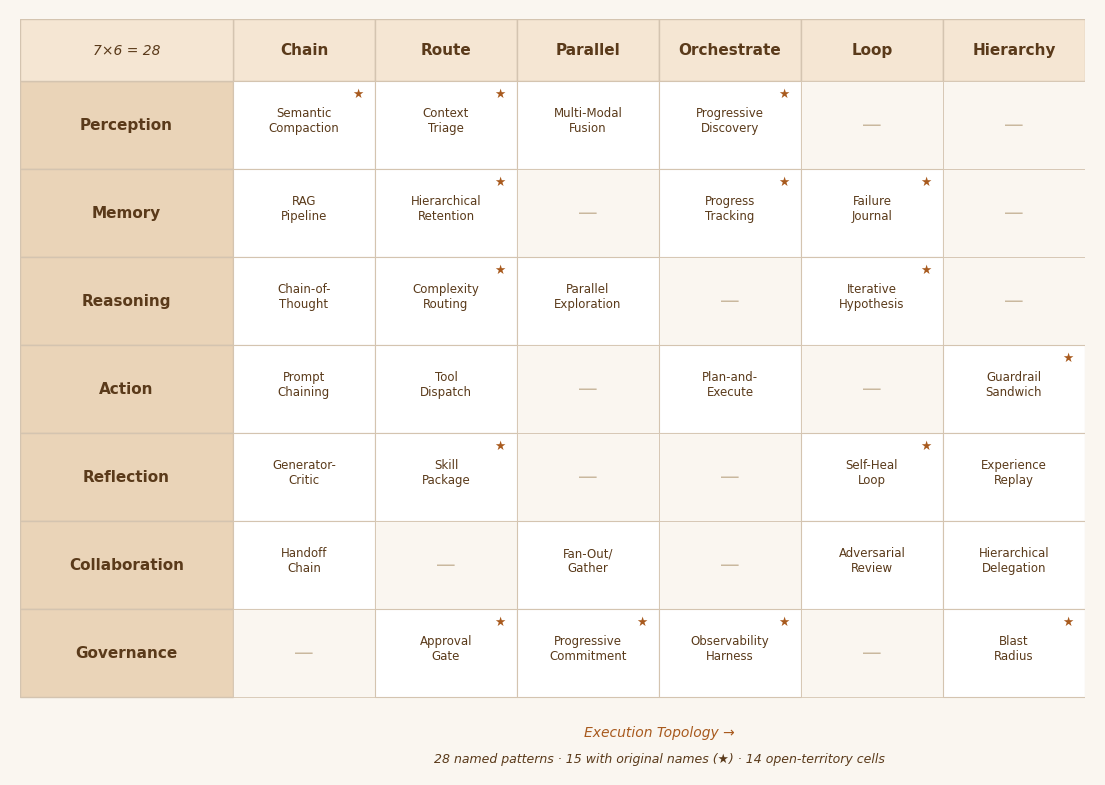
The dual-axis framework crosses the two views. Each agent design pattern is the intersection of one cognitive function and one execution topology. The 7×6 matrix yields 27 distinct patterns, 13 of them introduced and named in the work.

The two axes
Cognitive Function (7)
What the agent is trying to do.
- Perception — what enters the model
- Memory — what persists across turns
- Reasoning — how decisions are formed
- Action — how the agent affects the world
- Reflection — how the agent inspects itself
- Collaboration — how multiple agents combine
- Governance — how the system stays accountable
Execution Topology (6)
How the work is wired.
- Chain — sequential pass
- Route — conditional pick
- Parallel — concurrent spread
- Loop — iterative cycle
- Hierarchy — recursive split
- Orchestrate — dynamic conduct
A note on Choreography. Choreography is sometimes listed as a topology. We treat it instead as a coordination mode that operates across topologies — closer in spirit to the Teams pattern than to an independent execution shape — so it is described in the patterns text rather than given its own column.
The 7×6 pattern matrix — interactive
Three layers · how to navigate this reference
- This page (Layer 2) — the full 7×6 matrix. Each filled cell, each row header, each column header is clickable.
- Pattern pages (Layer 3) — deep dives into individual patterns. Why the pattern exists, the design problem it solves, deep thinking direction, curated engineering blog posts, latest arXiv papers. Five flagship samplers are published here as free reference. The remaining 22 patterns — each with full reverse engineering across five production frameworks, runnable Python code, typical pitfalls, and composition recipes — are developed in depth in Designing AI Agents (Manning, 2026).
- Aggregation views — click a row header (cognitive function) to see all patterns in that row together, plus the cross-cutting commentary on why this function matters and how topology choice changes its behavior. Click a column header (execution topology) for the same view along the orthogonal axis.
The five free samplers live at corners production engineers care about most: Context Triage, Hierarchical Retention, Hierarchical Delegation, Approval Gate, Observability Harness. They are enough to evaluate the framework. The other 22 are the book.
Each cell names the pattern at the intersection of one cognitive function and one execution topology. Empty cells (—) mark intersections where no recurring pattern is currently catalogued; some are structurally vacant, others are open research directions. Filled cells with a → arrow have a Layer 3 deep-dive page.
New companion view: Engineering Ancestors of Agent Design Patterns maps the pattern names below to older software-engineering ideas such as cache hierarchy, priority queues, Pipes-and-Filters, workflow DAGs, RBAC, Saga, MapReduce, and OpenTelemetry.
Cells with a → arrow have a Layer 3 deep-dive page open here as a free sampler. The remaining 22 patterns are full patterns in the framework — each is developed in depth, with five-framework reverse engineering and runnable Python, in Designing AI Agents (Manning, 2026). Web samplers stay open. Book chapters carry the engineering depth.
Orthogonality
The two axes are orthogonal in the engineering sense: the choice of cognitive function does not determine the choice of topology, and vice versa. The same cognitive function can be realized under different topologies with different cost, latency, and failure-mode profiles (e.g., Reasoning under Chain-of-Thought versus Iterative Hypothesis Testing). The same topology can serve different cognitive functions (e.g., Hierarchy carrying Guardrail Sandwich, Experience Replay, Hierarchical Delegation, or Blast Radius Control). The orthogonality is what makes the matrix usable as a selection grid rather than a taxonomy of fixed patterns.
Five empirical laws of pattern selection
The framework closes with five laws derived from cross-domain analysis (financial lending, legal due diligence, network operations, healthcare triage). Each law relates an environmental constraint to an architectural decision:
- Time → simplicity. Tighter time budgets compress topology toward Chain and Loop.
- Authority → governance. Higher action authority forces heavier Governance investment.
- Failure cost → reflection bias. Asymmetric failure costs justify Reflection layers that look uneconomic on average.
- Volume → collaboration. High task volume forces multi-agent topologies (Parallel, Hierarchy).
- Same pattern, different parameterization. Most production differences across systems are parameter choices on the same selected pattern, not different patterns.
These five laws are stated here as principles. The case studies that derive them — the financial-lending, legal due diligence, network-operations, and healthcare-triage analyses — the decision trees that apply them, the seven key discriminators that calibrate them, and the counter-examples where they break, are developed in Chapter 10 of Designing AI Agents. The web page gives you the laws; the book gives you the worked judgement.
How to cite
If you use the framework, its vocabulary (“dual-axis”, “Cognitive Function × Execution Topology”), its 27 pattern names, or its five empirical pattern-selection laws, please cite the formal source. Permanent canonical URL for this page: kage-ai.com/cite.
One-line citation
BibTeX
Dual-listed: eprint = arXiv primary surface; doi = Zenodo permanent archive.
Chicago short-form
Huang, Jia, and Joey Tianyi Zhou. “A Two-Dimensional Framework for AI Agent Design Patterns: Cognitive Function × Execution Topology.” arXiv preprint arXiv:2605.13850 (2026). https://arxiv.org/abs/2605.13850.
The Zenodo DOI 10.5281/zenodo.19036557 remains the permanent archival identifier (originally posted 2026-03-12, predating the arXiv submission and serving as priority timestamp).
Where the framework is developed
- Paper — arXiv:2605.13850 (Huang & Zhou, 2026): the formal taxonomy, orthogonality argument, eight detailed patterns, and the five empirical laws. Archival DOI: 10.5281/zenodo.19036557.
- Book — Designing AI Agents (Manning, MEAP launches May 26, 2026): the full eleven-chapter engineering treatment, all 27 patterns implemented in Python, the running case study (Argus), and the six-step pattern-selection methodology.
- Essays — Writing archive and Agent Design Patterns on Substack: deployment notes, dollar economics, and the engineering arguments behind individual patterns.
This page is the canonical reference URL for the dual-axis framework. It is meant to be cited and linked rather than reproduced — the matrix evolves as the patterns evolve.